





Remote closings rarely fall apart in obvious ways. They don’t usually fail because something completely breaks. More often, they slow down step by step until the process starts feeling harder than it should be.
At the beginning, everything looks structured. Documents are prepared. The timeline is clear. All participants are aligned. On paper, nothing seems complicated.
Then the session starts.
Someone takes longer to join. A document needs to be reviewed again. One step pauses longer than expected because the next action isn’t immediately clear.
Individually, these moments don’t seem important. But together, they change how the closing feels. Instead of moving forward naturally, the process starts depending on coordination. People wait, check, confirm, and adjust in real time.
That’s when remote closings stop feeling efficient. And that’s usually where the platform behind the process becomes more important than expected.
A Closing Is a Connected Process, Not a Set of Tasks
One of the reasons remote closings are harder to get right is that they are not a single action. They are a sequence that needs to stay intact from start to finish.
Documents need to be reviewed in the correct order. Participants need to complete their parts without confusion. Verification, signing, and notarization need to happen without breaking the flow.
If one part becomes unclear, everything behind it slows down. That’s why the structure of the process matters more than individual features. What starts to matter in real scenarios:
- Whether participants can move through the session without stopping to ask questions.
- Whether each step leads naturally into the next one.
- Whether documents are prepared well enough to avoid mid-session corrections.
- Whether multiple participants can complete their parts without creating delays.
A closing works when the process feels continuous.
The Real Problem Is Not Complexity, It’s Friction
Closings are already complex by nature. There are multiple documents, legal requirements, and different roles involved. That part cannot be simplified away. What can be reduced is friction.
Friction appears when the system adds extra steps that don’t need to be there. When participants are unsure what to do next. When the process requires manual coordination instead of guiding itself.
Most platforms handle the core functionality. But not all of them handle the transitions between steps well. And that’s where most delays come from.
Preparation Matters More Than the Session Itself
A large part of whether a closing works is decided before the session begins.
If documents are incomplete, the issue will appear during the session. If the structure is unclear, participants will hesitate. If the system doesn’t guide the flow, someone will have to manage it manually.
The session doesn’t fix those problems. It exposes them. That’s why platforms that support preparation tend to make a noticeable difference in how closings actually run.
1. OneNotary
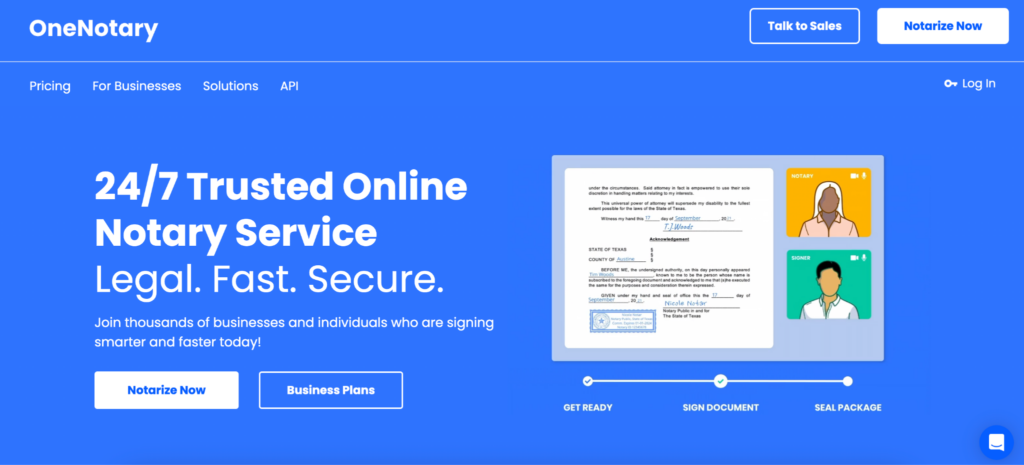
OneNotary is built in a way that supports the full flow of a closing, not just the notarization step.
The process is guided from the moment the session begins. Participants don’t need to interpret what happens next or rely on external instructions. The platform moves them through each stage in a consistent sequence.
That becomes especially useful in real estate and financial transactions, where multiple documents and signers are involved.
What supports the process in practice:
- Sessions connect to a live notary quickly, which prevents early delays
- Documents are checked before the session, reducing the chance of mid-session corrections
- Each step follows a clear order, so participants don’t pause to figure out what to do
- Multi-step signings stay structured instead of becoming fragmented
The session doesn’t feel like something that needs to be managed manually. It follows a path that holds together from beginning to end.
2. Notarize (Proof.com)
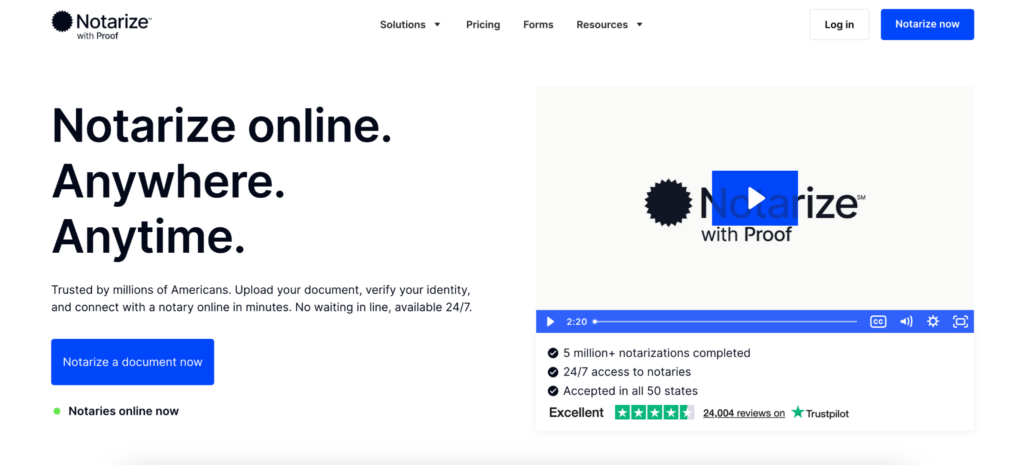
Notarize is commonly used in environments where closings happen regularly and need to follow a predictable structure.
The platform keeps the process consistent across different sessions, which helps reduce variation when multiple closings are handled in parallel.
What becomes noticeable over time:
- Sessions follow the same flow regardless of document type.
- Participants can complete steps without additional explanation.
- The system supports real estate workflows without requiring custom adjustments.
- documents move through signing and notarization without unnecessary separation.
That consistency makes it easier for teams to handle volume without having to rethink the process each time.
3. NotaryCam
NotaryCam is often used in closings that involve more detailed coordination.
Some transactions include multiple parties, cross-border elements, or document sets that require more structured handling. The platform accounts for those scenarios instead of simplifying them.
What that looks like during a session:
- Support for multiple participants joining at different points.
- Structured handling of more complex document requirements.
- Workflows that accommodate additional verification steps.
- Coordination that doesn’t depend entirely on manual oversight.
The process reflects the complexity of the transaction instead of trying to flatten it into a generic flow.
4. DocuSign Notary
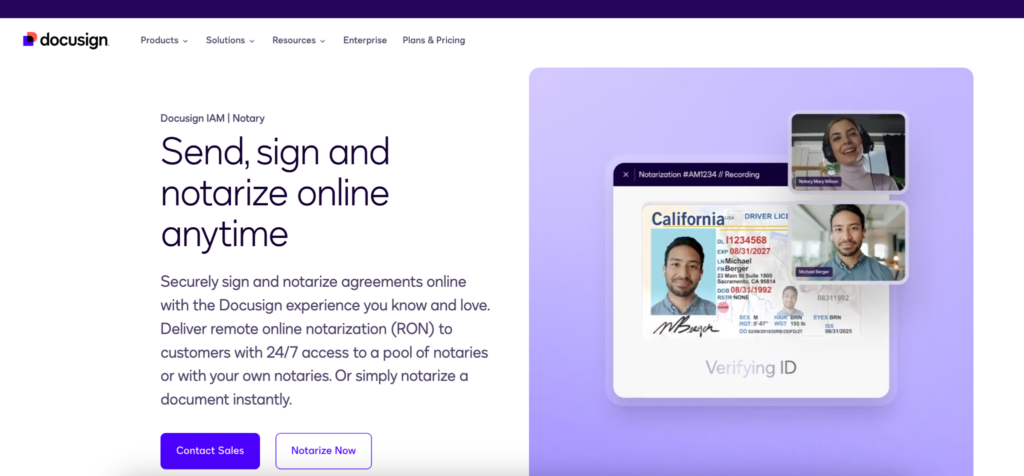
DocuSign Notary fits into closings where document signing is already part of a larger system.
Instead of separating signing and notarization into different tools, both steps happen within the same environment. That removes a layer of transition that often slows things down.
What changes in practice:
- Participants stay in one interface throughout the process.
- Documents move directly from signing to notarization.
- Teams don’t need to coordinate between separate systems.
- The overall flow feels more continuous.
That continuity becomes more important when multiple documents are involved and need to be handled in sequence.
5. BlueNotary

BlueNotary is often used by teams that want to adjust how closings are handled internally.
Rather than following a fixed structure, it allows businesses to shape parts of the workflow based on their own process.
What that enables during closings:
- Adjusting the flow to match internal requirements;
- Maintaining visibility over how sessions are handled;
- Aligning notarization with existing operational steps;
- Adapting the process when different types of closings are involved.
This flexibility can be useful when closings are not identical and need to follow slightly different paths.
Where Closings Start to Lose Momentum
Closings rarely stop completely. They slow down. A transition takes longer than expected. A participant hesitates because the next step isn’t clear. A document needs to be reviewed again in the middle of the session.
Each delay creates a small break in the flow. And once those breaks start to repeat, the process feels less controlled. Instead of moving forward on its own, it depends on someone managing every step.
Why Predictability Matters More Than Speed
Speed is noticeable at the beginning of a session. Predictability is what keeps it moving. If every step behaves the same way, participants know what to expect. They don’t need to stop and adjust. They don’t need to double-check each action.
That consistency reduces the need for coordination. And in closings, that matters more than shaving a few seconds off individual steps.
Where AI Supports the Process
AI is most useful in closings when it reduces issues before they appear. Not during the session, but before it begins.
In practical terms, that includes:
- Checking documents for missing or incorrect fields;
- Preparing files so they don’t require correction mid-session;
- Identifying patterns in where delays usually occur;
- Improving how documents are handled across repeated closings.
These changes don’t alter the visible process. They reduce the number of moments where something goes wrong.
What Makes a Closing Feel Smooth
A smooth closing is not one where everything happens faster. It’s one where nothing interrupts the flow.
Participants move through the process without needing clarification. Documents don’t need to be revisited. The session doesn’t depend on constant coordination.
That’s usually the result of a system that connects all parts of the process instead of treating them separately.
When the Process Starts Holding Together
At some point, the difference becomes clear. In one case, the closing feels like a sequence that keeps moving. In another, it feels like a set of steps that need to be managed manually.
The tools may look similar on the surface. But the way the process behaves is different.
And in remote closings, that difference shows up almost immediately once the session begins.